Muon/Vortex
"Muon/Vortex" along with Sudhu Tewari's "Drains and Planes" will be on view at Not/Ready Gallery till Febuary 2026
Intention and Chance
Muon/Vortex operates at the boundary between intention and chance. Rather than composing movement directly, the work establishes a system in which natural events—cosmic particles arriving from deep space—determine when motion begins, how long it lasts, and when it subsides. The artist designs the conditions, but the timing belongs to the cosmos.
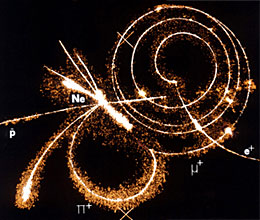
This image is of an antiproton annihilating against a neon (Ne) nucleus. The sequence of decay is visible, with a pion decaying into a muon. The spiraling tracks are characteristic of particles as they lose energy.
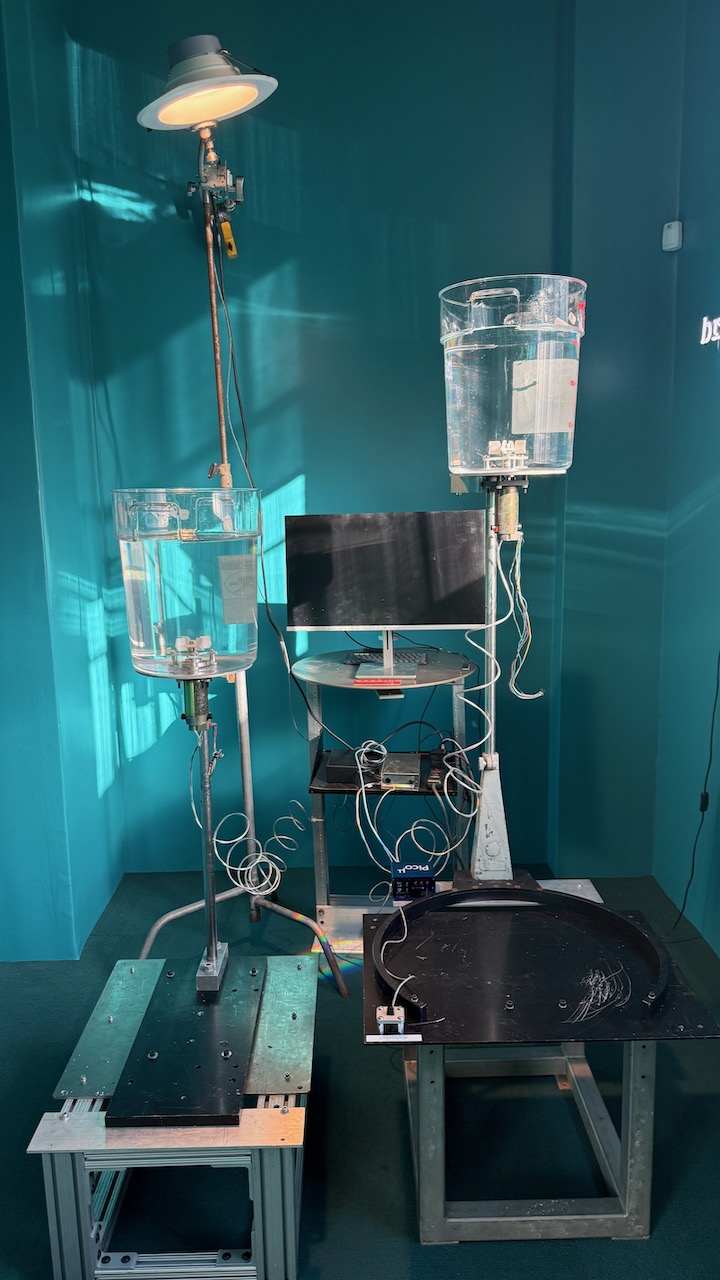
The work is activated by muons—particles created when cosmic rays collide with Earth’s atmosphere. Muons pass silently through matter, rarely interacting with anything they encounter. When one does activate the detector, vortices form, accelerate, relax, and dissolve. Extended pauses allow the surface to settle into reflective calm, while clustered arrivals drive turbulence that carves ribs and channels through the flow.
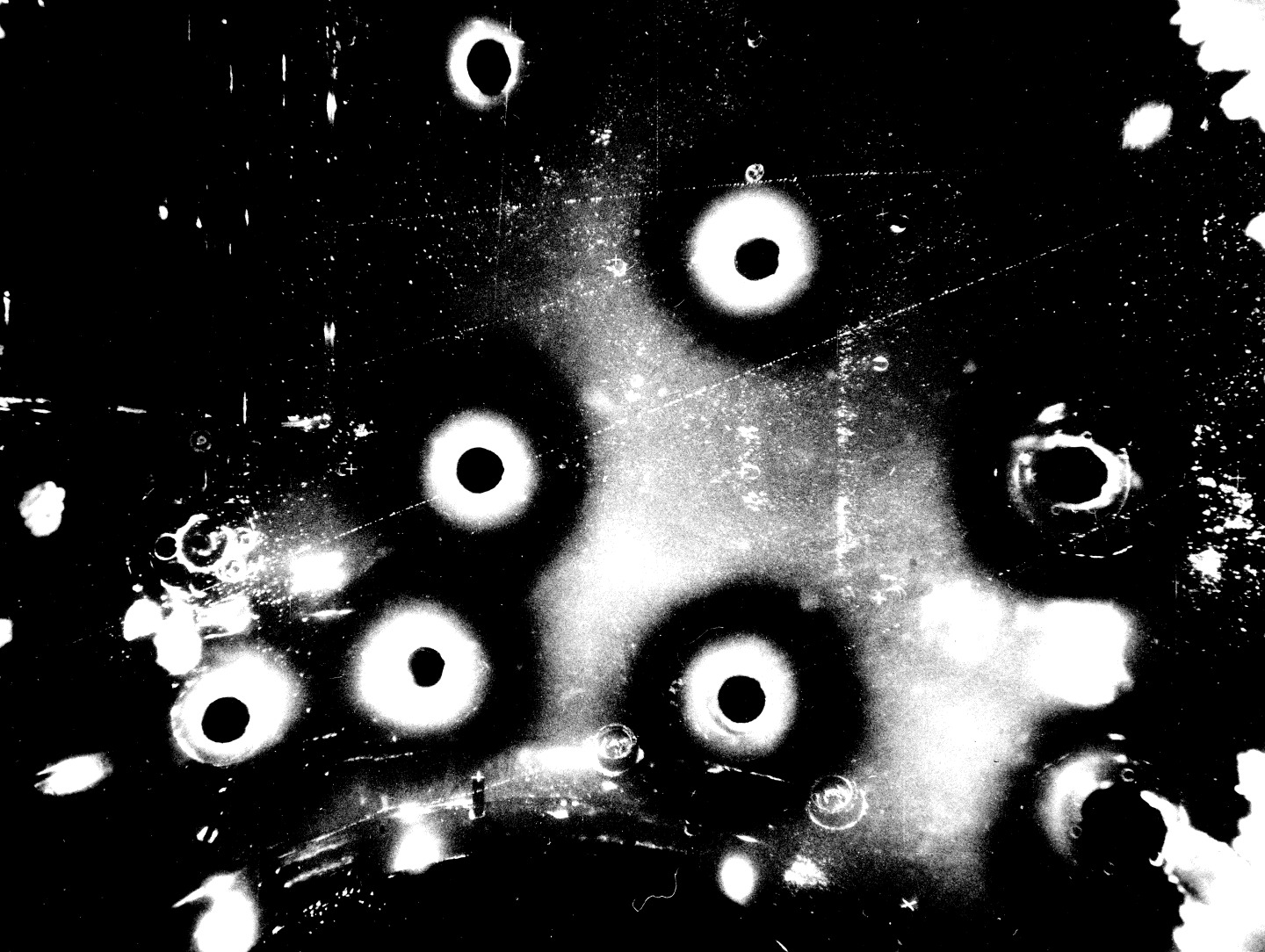
"Particle Collisions" CERN Document Server
What appears as choreography is not scripted but contingent—shaped by distant astrophysical processes unfolding far beyond human scale. In giving these events physical consequence, the work renders chance as a material force, revealing a quiet correspondence between cosmic time and embodied experience. The installation becomes less a machine performing a task than a situation in which unseen forces are allowed to leave a trace.
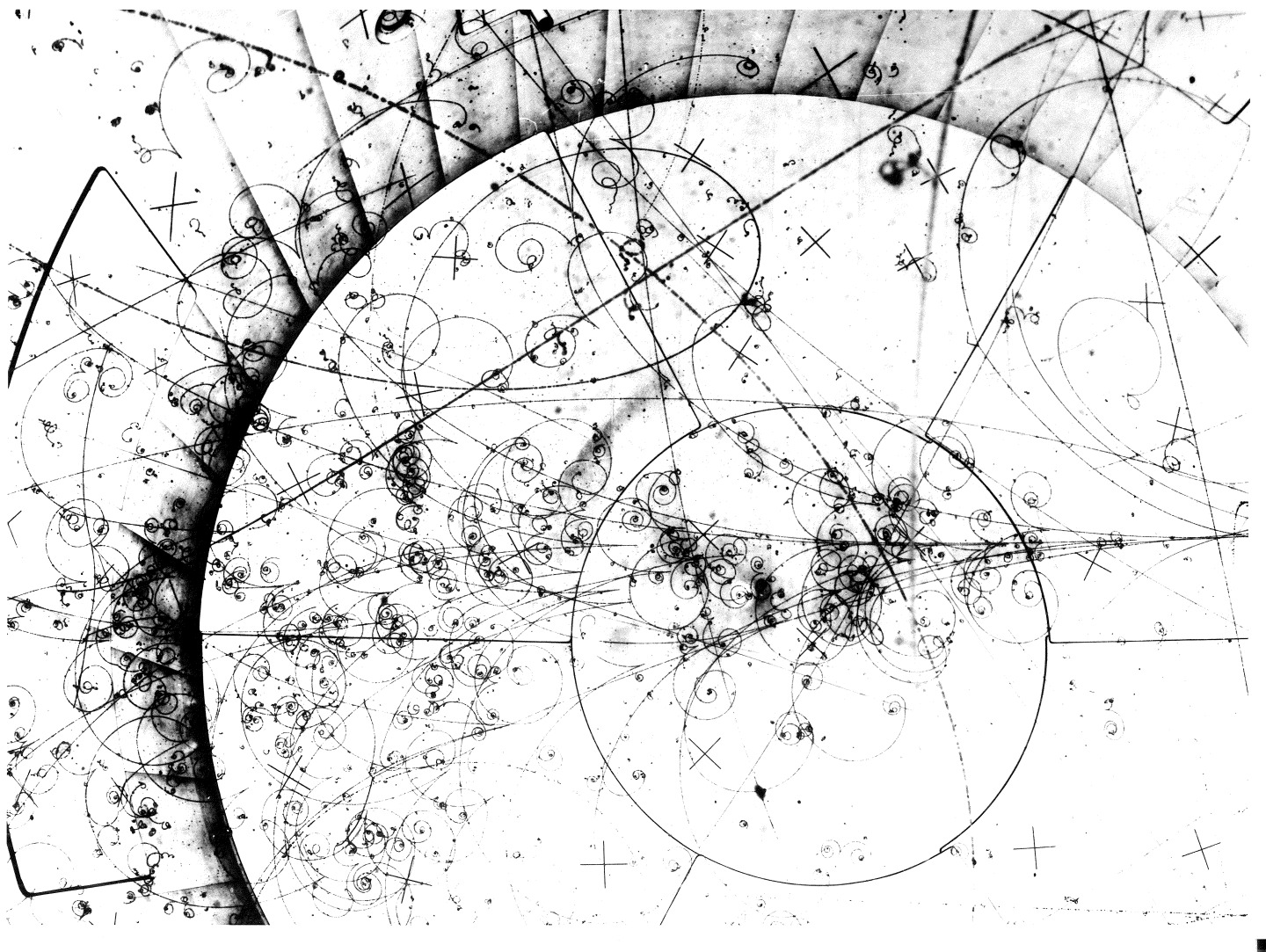
"Particle Collisions" CERN Document Server
Cosmic Origin and Decay
High-energy shock waves and turbulent magnetic fields permeate the galaxy. Supernova explosions, stellar winds, and other violent astrophysical events disturb these fields, folding them into vast spirals and knots that persist for millions of years. Charged particles—primarily protons—become trapped within this magnetic turbulence, scattering and accelerating as they spiral through interstellar space. By the time one of these particles reaches the Earth, it may have wandered for millions of years, its precise point of origin effectively erased by the chaotic geometry of the fields that carried it.
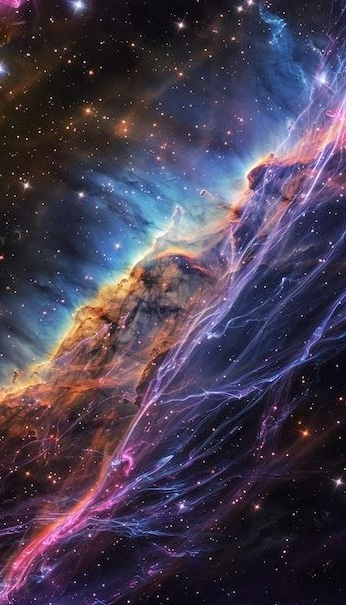
The Veil Nebula is a well-known supernova remnant. Its intricate, colorful filaments form as fast-moving debris from the explosion plows into surrounding interstellar gas, creating shock fronts that accelerate particles as they propagate outward.
When a cosmic ray strikes the upper atmosphere, it collides with atomic nuclei at extreme energy, triggering a cascading shower of secondary particles that unfolds within microseconds. Among the earliest products are pions—unstable particles that exist for only about twenty-six nanoseconds before decaying. Some decay into photons, while others decay into muons and neutrinos. It is these muons, created high above the Earth, that carry the event downward toward the surface.
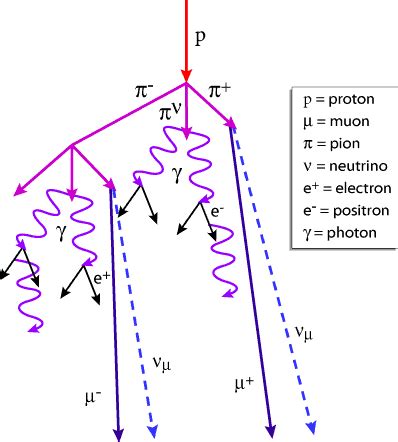
Muons are heavier relatives of the electron and are born traveling at nearly the speed of light. Although their natural lifetime is only 2.2 microseconds, relativistic time dilation allows many of them to survive the journey through tens of kilometers of atmosphere. From the muon’s perspective, the distance to the Earth’s surface is shortened; from ours, the muon’s internal clock runs slow. This effect allows particles created in the upper atmosphere to reach the ground, passing through concrete, steel, water, and living bodies while interacting only weakly with matter.
The installation detects muons using two stacked scintillators. When a muon passes through a scintillator, it excites electrons in the material, producing a tiny flash of light lasting only billionths of a second. Light sensors register these flashes, and only when both scintillators fire simultaneously is the event recorded, confirming the passage of a single particle through both detectors. This coincidence requirement filters out background radiation, isolating events that originated in the atmosphere above.
Each confirmed detection is translated into the formation of a vortex. Rather than composing motion directly, the work allows the timing between particle arrivals to determine how the water behaves. Long intervals between detections allow the surface to settle into smooth, reflective calm; clustered arrivals generate turbulence, carving ribs and channels into the flow. What appears as choreography is contingent, shaped by astrophysical processes unfolding far beyond human scale.
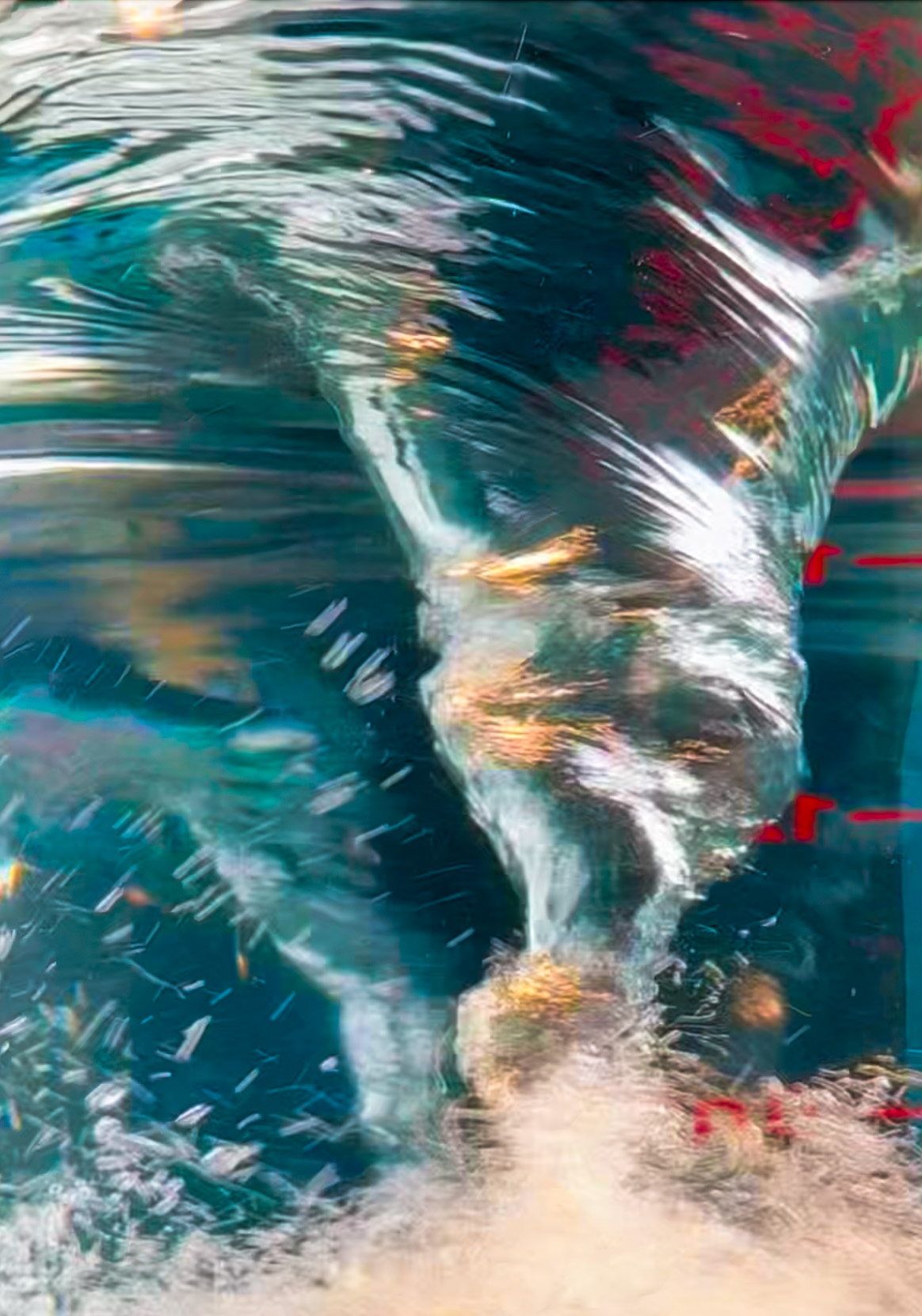
Every muon detected here is already near the end of its existence. After passing through the installation, it decays into an electron and neutrinos, disappearing as quietly as it arrived. The work gives this brief interval—between creation and decay—a material presence, linking galactic timescales and relativistic physics to immediate, embodied experience. Energy that has traveled for millions of years is allowed to briefly inscribe itself into water before vanishing again.
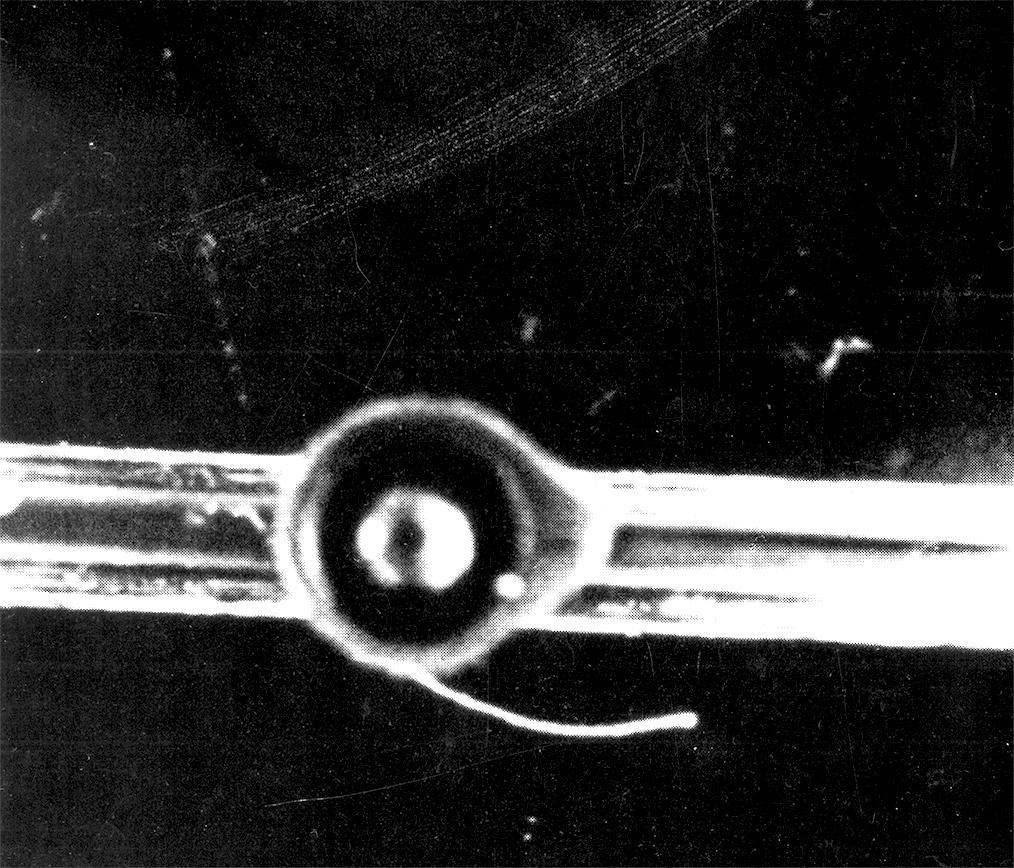
The picture shows the track of a positive meson(The name has been changed to muon) which was slowed down in the aluminum absorber and finally decayed in the gas of the chamber with the emission of a positron, the positron furnishing the delayed triggering count. See S H. Neddermeyer and C.D. Anderson, Phys. Rev., 54, 88, 1938 Taken fron W. Gentner, H. Meier-Leibnitz and W..Bothe, An atlas of," typical expansion chamber photographs, 167 Pergamon Press, 1951
Materials & Systems
- Detection: PicoMuon cosmic-ray detector (UK Radio Astronomy Association)
- Computation: Raspberry Pi 5 microcomputer
- Software: openFrameworks (open-source C++ environment)
- Actuation: Dual-channel 6–24V, 10A DC motor drivers
- Motors: Gearless Pittman Lo-Cog 24 VDC motors
- Coupling: Custom magnetic couplers (hybrid-manufactured)
- Fluid Interfaces: 3D-printed impellers
- Structure: Aluminum and stainless steel, polycarbonate vessels, bearings, shafts, and nylon fasteners
- AI Tools: ChatGPT, Claude