Muon/Vortex
The Artwork
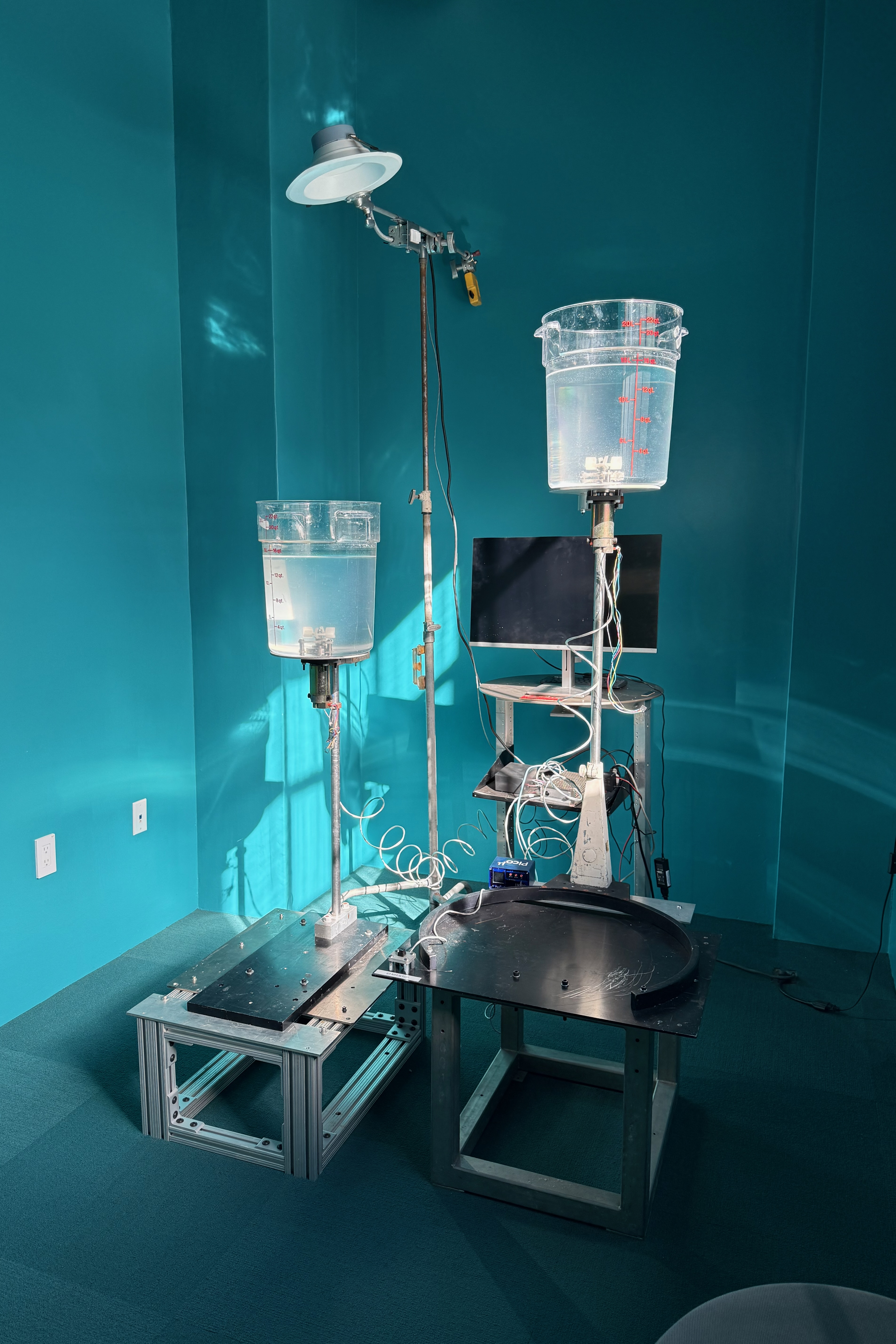
Muon/Vortex is a sculptural system in which cosmic particles called muons, arriving randomly from deep space, activate a detector, which in turn activates vortexes in two water-filled containers. Extended pauses between the muons' arrival allow the water's surface to settle into reflective calm, while clustered arrivals drive turbulence that carves ribs and channels through the flow.
The artist designs the conditions, but the timing belongs to the cosmos.
Art Historical Precedents
I imagine Muon/Vortex as participating in a long lineage of artworks incorporating machines (considered broadly) and chance. The Dadaist poet Tristan Tzara, known for creating poems by pulling random words from a hat (or his pocket), is a key influence. Chance for him was a collaborator, not a flaw—a portal through which the world itself could speak, and reveal a deeper and more honest order than anything the poet could impose. Although the elements Tzara used were linguistic and his "machine" a simple container, Muon/Vortex extends his gesture. Instead of a bag of cut-up words, it responds to the arrival of atmospheric particles. In Muon/Vortex, the artist's job is not to compose but to listen. The universe provides the text; a detector translates it; the water vortex gives it voice.
Other precedents I've found inspiring include Brian Eno, a cofounder of the Long Now Foundation, who is known for using generative systems and algorithmic randomness to produce music that in a sense composes itself; Rebecca Horn, who uses mechanical extensions, kinetic objects, and repeated actions to translate longing, vulnerability, and constraint into physical form; Rafael Lozano-Hemmer, who uses unpredictable human inputs—breath, heartbeats, movement—as chaotic seeds that drive visual and kinetic work; and Ryoji Ikeda, who uses data streams, noise processes, and probabilistic systems to generate audiovisual experiences.
Scientific Precedents
I've been interested in astronomy since I took a course in college that really opened the sky up in persistent ways. Later I started to dig deeper into cosmology, since it offered theories that produced mind-bending, stranger-than-fiction facts that in many ways influence my understanding of the world. The fact that the scientific narrative changes when new discoveries are made parallels my iterative methodologies as an artist.
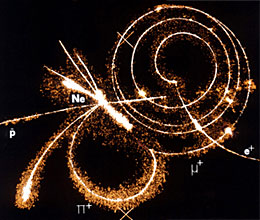 This image is of an antiproton annihilating against a neon (Ne) nucleus. The sequence of decay is visible, with a pion decaying into a muon. The spiraling tracks are characteristic of particles as they lose energy.
I am inspired by bubble chambers, the Hubble and James Webb space telescopes, quantum microscopes, and all sorts of other tools that reveal phenomena that would otherwise never be visible to humans. I include such imagery as illustrations here in the hopes that science-oriented readers will know I don't enter into my research lightly, and that more art-oriented readers will appreciate the sheer beauty of the spirals, curves, and other geometries, without necessarily needing to know that they derive from interstellar magnetic fields or decaying particles.
So many things are under attack these days, and art and science are practices that I hold dear. I make art with science to celebrate how these vastly different activities can enrich our lives.
Cosmic Origins
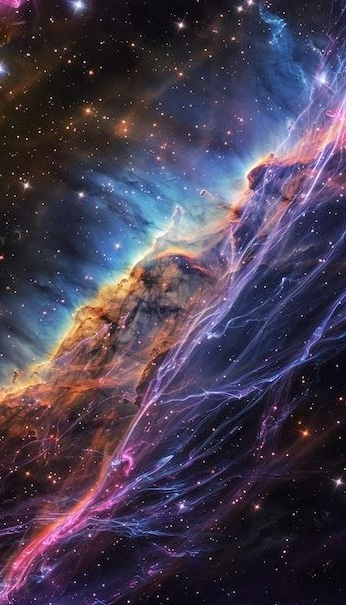 The Veil Nebula is a well-known supernova remnant. Its intricate, colorful filaments form as fast-moving debris from the explosion plows into surrounding interstellar gas, creating shock fronts that accelerate particles as they propagate outward.
Charged cosmic particles are accelerated and scattered by turbulent magnetic fields shaped by violent astrophysical events, for instance supernova explosions. By the time one of these particles reaches the Earth, it may have wandered for millions of years, its precise point of origin effectively erased by the chaotic geometries of the fields that carried it. Upon striking Earth's upper atmosphere, it triggers a cascading shower of secondary particles that unfolds within microseconds. These include pions, photons, neutrinos, and—important for my purposes—muons.
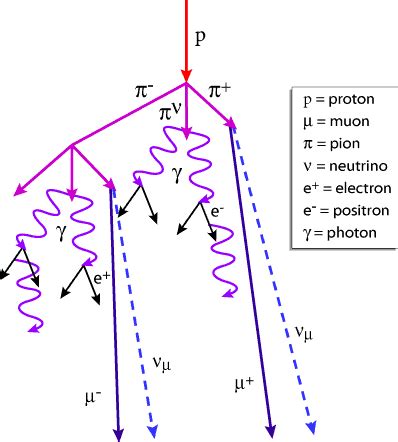
Muons are born traveling at nearly the speed of light. Although their natural lifetime is only 2.2 microseconds, relativistic time dilation allows many of them to survive the journey through our atmosphere. They likewise pass through concrete, steel, water, and living bodies while interacting only weakly with them.
Unlike other kinds of particles that reach the Earth's surface from space, muons don't require expensive equipment to detect them. Indeed, they can be detected using a DIY mashup of Geiger tubes and coincidence circuits. Muon/Vortex detects muons via a relatively simple apparatus, namely two stacked scintillators. When a muon passes through a scintillator, it excites electrons in the material, producing a tiny flash of light (lasting only billionths of a second, but still detectable). When both scintillators fire simultaneously, we know that a muon has passed through, as opposed to background radiation, which would have been stopped by its interaction with the first scintillator it encountered.
Every muon detected here is already near the end of its existence. After passing through the installation, it decays into an electron and neutrinos, disappearing as quietly as it arrived.
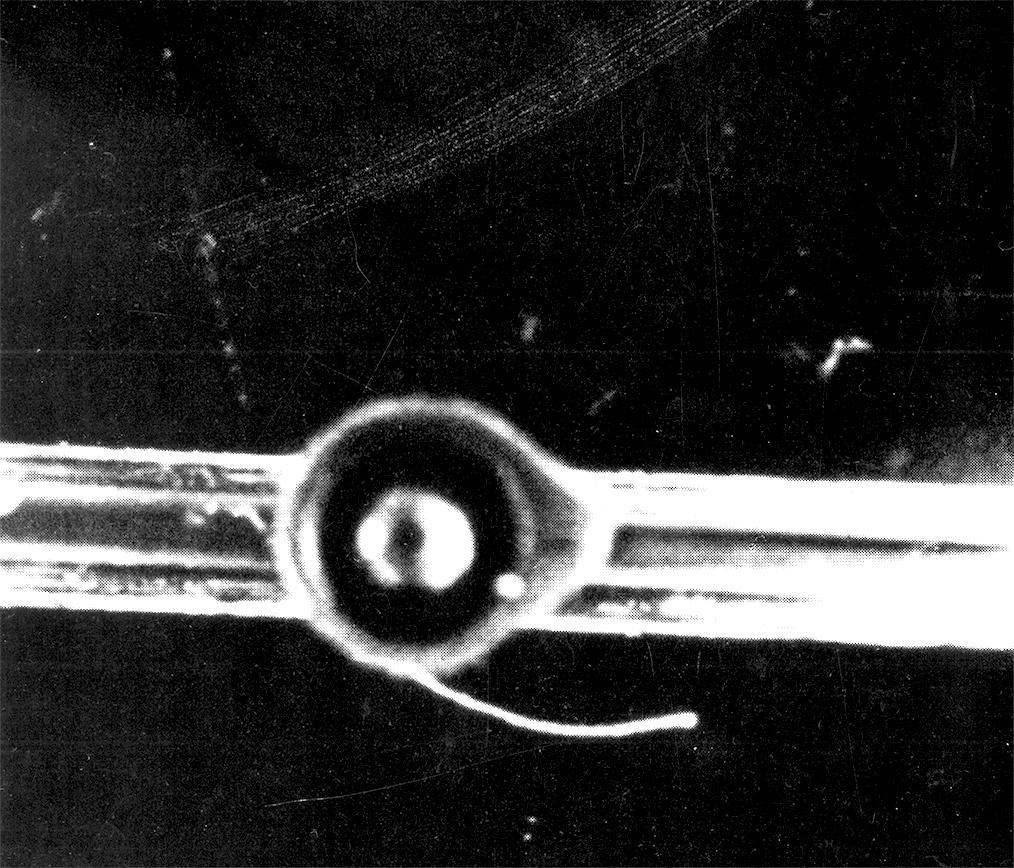 The picture shows the track of a positive meson (the name has been changed to muon) which was slowed down in the aluminum absorber and finally decayed in the gas of the chamber with the emission of a positron. See S.H. Neddermeyer and C.D. Anderson, Phys. Rev., 54, 88, 1938. Taken from W. Gentner, H. Meier-Leibnitz and W. Bothe, An Atlas of Typical Expansion Chamber Photographs, Pergamon Press, 1951.
Back to the Artwork
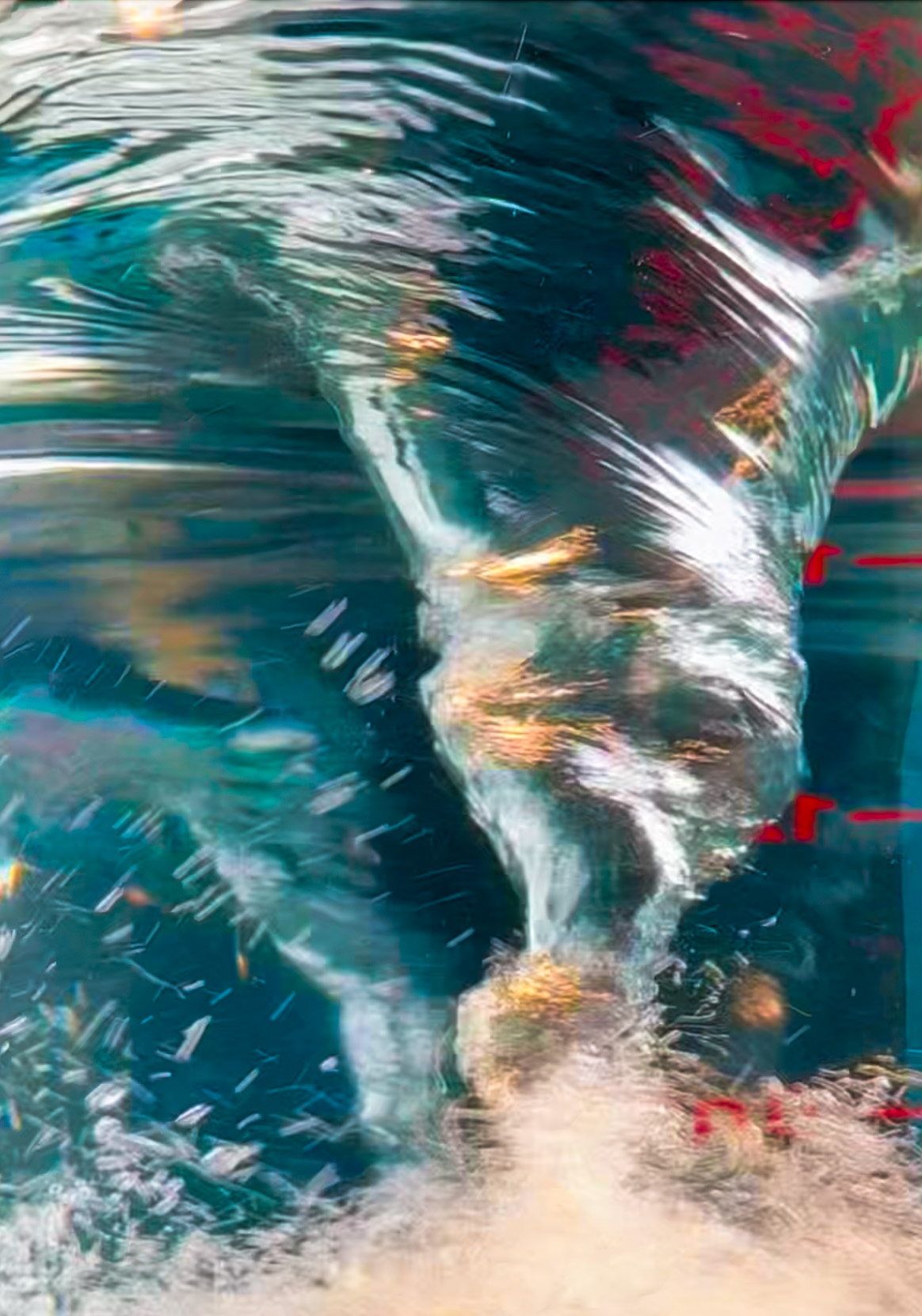
The visible manifestation of the muons' arrival in Muon/Vortex are the two water vortexes. (A microcontroller determines the duration and speed of the motors based on the rate of the muon strikes.) I could have manifested the muons' arrival in any of a variety of ways—for instance a sound or a flashing light—but because I am fundamentally a sculptor, this felt appropriately three-dimensional, poetic, and durational. Rather than composing motion directly, the work allows particle arrivals to determine how the water behaves. What appears as choreography—formation, acceleration, and relaxation—is actually determined by astrophysical processes unfolding far beyond human scale.
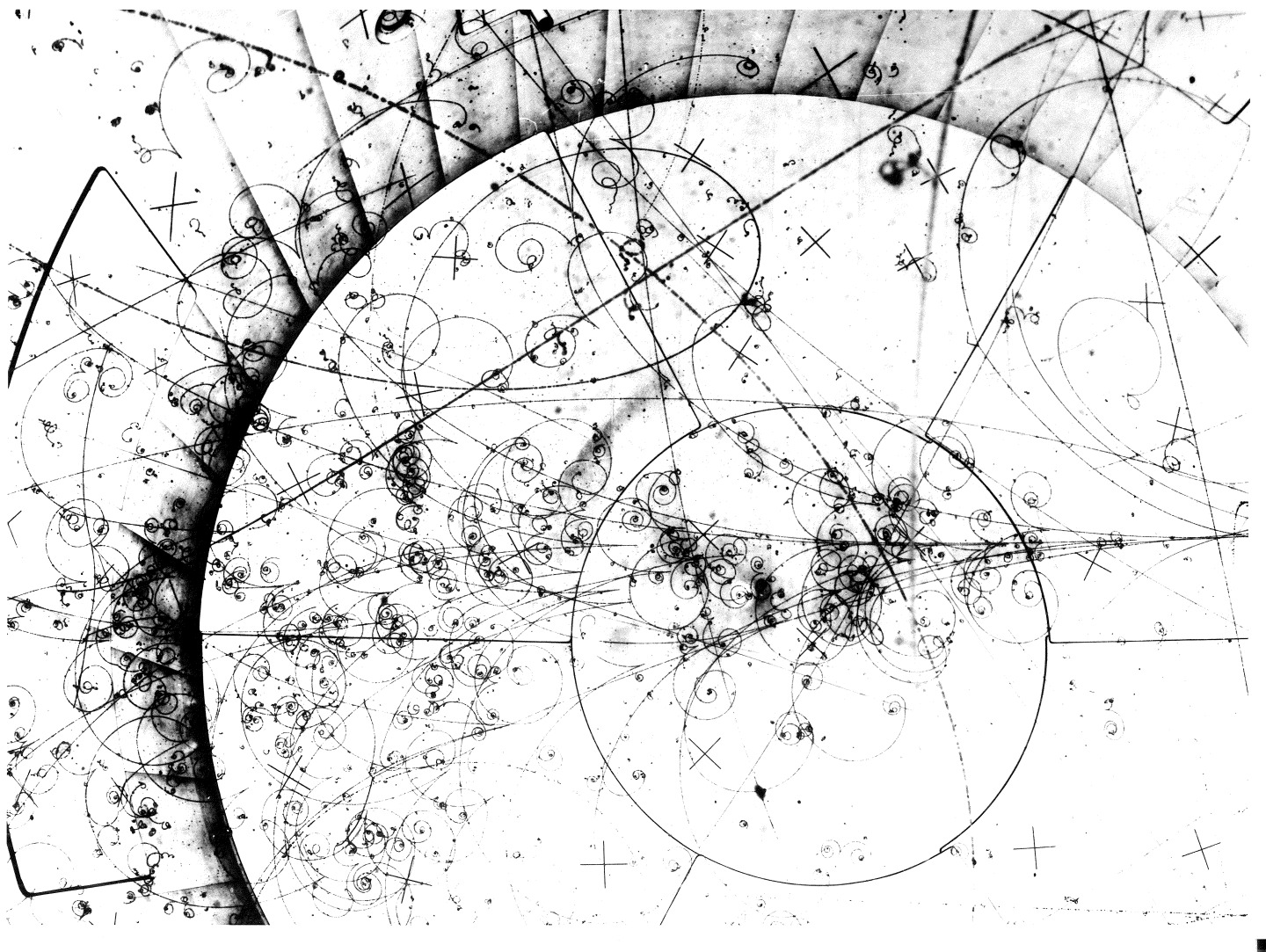 "Particle Collisions" CERN Document Server
I also find poetic resonance between my water vortexes and, for instance, the way particles spiral as they lose energy and decay.
In giving fleeting cosmic events physical consequence, the work renders chance as a material force, revealing a quiet correspondence between cosmic time and embodied experience. The installation becomes less a machine performing a task than a situation in which unseen forces are allowed to leave a trace. Energy that has traveled for millions of years briefly inscribes itself into water before vanishing again.
Materials & Systems
- Detection: PicoMuon cosmic-ray detector (UK Radio Astronomy Association)
- Computation: Raspberry Pi 5 microcomputer
- Software: openFrameworks (open-source C++ environment)
- Actuation: Dual-channel 6–24V, 10A DC motor drivers
- Motors: Gearless Pittman Lo-Cog 24 VDC motors
- Coupling: Custom magnetic couplers (hybrid-manufactured)
- Fluid Interfaces: 3D-printed impellers
- Structure: Aluminum and stainless steel, polycarbonate vessels, bearings, shafts, and nylon fasteners
- Assisters: Claude, ChatGPT